1. Tell us a bit about yourself: where are you from, and what was your path to psychoanalysis?
My name is Zhanna, and I am a psychoanalyst. I work with the things people have carried inside them for years, helping them finally hear their own voices. My path here wasn't a straight line; my first degree was actually in Physics and Mathematics. I don’t think anyone ever arrives at psychoanalysis via a direct route.
I studied at the International Institute of Depth Psychology, but my education is ongoing. This isn't just a formality—in psychoanalysis, you never truly "finish" learning. Currently, I live and practice in London, working both offline and online with clients from all over the world. In parallel, I am building something I care very deeply about: a therapeutic centre for children.
2. What does a typical workday look like for you?
My day begins with text. Even before my first session, I jot down thoughts that come to me during the night or early morning. A psychoanalyst is always "on," even before the official clock starts. Then, I move into sessions with clients.
During breaks, I integrate movement: fitness, yoga, or running. Sometimes it’s a 10-kilometre walk along a brand-new route—I try to choose a different path every time because the brain craves novelty just as much as the body craves healthy fatigue.
Between and after sessions, there is a lot of work with texts: clinical articles, theoretical papers, and my own blog. I write because I believe that one well-placed question to my audience can prompt someone to stop and see themselves—their desires, their partners, or their children—differently. This is just as vital as one-on-one work.
In the evening, I usually read. Throughout the entire day, PDF Expert is my constant companion. I open the notes I made in the morning, add to them, connect ideas, convert them to PDF, and highlight keywords for my team. I use PDF Expert about fifteen times a day on average; that’s no exaggeration. It’s simply how my workflow is built.
3. How do you use technology to be more productive?
I’m not a fan of the word "productivity" in its usual sense—doing more in less time. For me, the question is different: how do I create a space where thinking happens without unnecessary friction? Because of this, I use a few select tools, each with its specific place.
- PDF Expert: This is my primary workspace for text on my iPhone. I use it to read books and academic articles, underline passages, and leave comments to revisit during session prep. It’s not just a "reader"—it’s where the text comes alive. I also use it for everyday tasks, such as signing documents or making simple visual measurements. When I recently moved into a new apartment, I literally used PDF Expert to measure the height of a painting on the wall to make the interior look harmonious. [Learn about PDF Expert's Measurement tools here]
- Notion: Holds the structure of my long-term projects and research.
- Miro: For those moments when thoughts haven't yet become words, but the connections—conceptual maps and diagrams—are already there.
- Claude: Helps with large volumes of material, analyzing, formulating, and editing texts.
- Simple Tools: Voice Memos for thoughts that strike while I’m on the move, Notes for quick captures, and Goals Fitness as a reminder that physical and mental energy are more closely linked than we think.
4. Do you think AI will change your work?
AI is excellent at handling information. However, psychoanalysis is not about information; it is about how a human experiences their own life. It deals with the things a person cannot name but which define everything: their choices, their relationships, and their suffering. An algorithm has no access to this space because it lacks an unconscious—and likely always will. Therefore, AI cannot replace clinical work.
I use AI where it is genuinely useful: processing large amounts of text, structuring material, and preparing research or educational projects. It is a massive time-saver.
5. Which five mobile apps would you recommend to your colleagues?
- PDF Expert: For working with clinical texts, books, research, and documents. Indispensable.
- Notion: For structuring thoughts, projects, and educational materials. The architecture of my work lives here.
- Calendars by Readdle: Essential for maintaining the "setting" of my practice. It’s a great meeting planner and time organizer.
- Voice Memos: For capturing thoughts on the go.
- Google Drive: To ensure everything is accessible from anywhere and nothing gets lost.
6. Please share your experience with PDF Expert: what do you like most, and which features do you use daily?
For me, PDF Expert is a space where the text continues to "think" along with me. I don’t just read; I leave tracks. I highlight fragments and write comments directly in the margins. When I return to these notes later, I can see how my understanding has evolved. This is essentially the psychoanalytic method applied to reading.
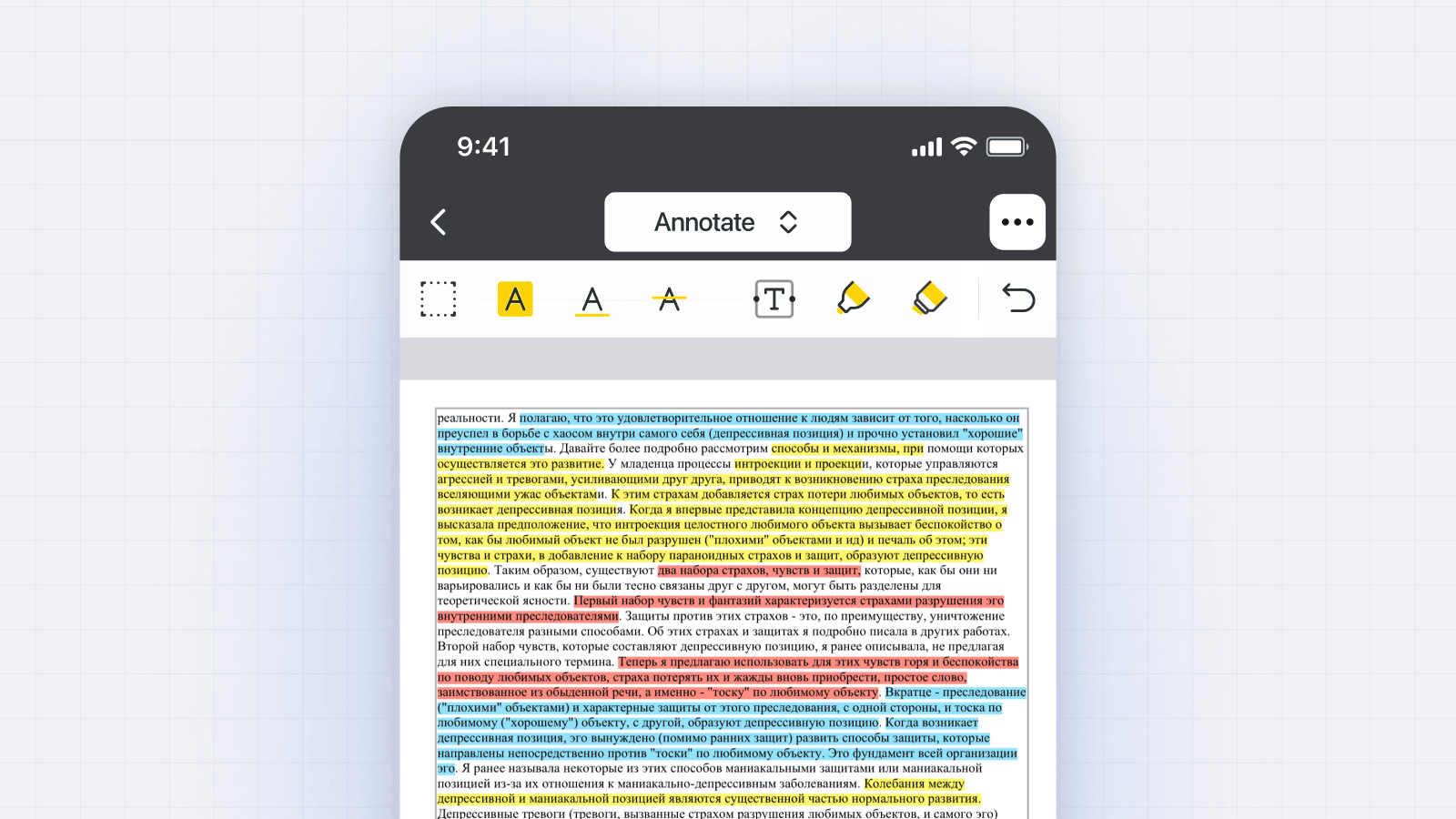
Color-coding helps me distinguish types of information: theory, clinical examples, questions, or ideas. The search function allows me to find a specific quote in a dense text in seconds. Working with multiple documents side-by-side lets me keep a book, an article, and my own notes all within my field of vision at once. Over time, PDF Expert has become my living library.
7. What inspires you in your daily life?
The moment a person begins to speak differently. It’s not just that they’ve reached a conclusion; it’s that their speech has changed—it becomes slower, more precise, more "theirs." That is the sign that something has shifted internally. The entire work exists for that moment.
I am also inspired by books—proof that someone before you has thought about these things and found the words. It’s a special feeling of not being alone in your thinking. Finally, things that return me to lived experience: art, photography, the aesthetics of a space, and flowers. And chess: a reminder that thinking can be a game—precise, deep, and yet light.
8. A piece of productivity advice for your audience?
No system works without desire. If you don’t understand why you are doing what you are doing, time management just makes your busyness more organized—nothing more. I believe there are three steps, in this specific order:
- Find your "Why": Not a goal in a planner, but a living question that genuinely moves you. The thing you think about without reminders, the thing that won't let you go, even when you're tired. That provides the energy no deadline can replace.
- Create a Structure: Carve out specific time for important work and protect it from everything that is louder or more "urgent." Put it in your calendar as seriously as a meeting with another person. In psychoanalysis, we call this the "setting"—the constant frame within which deep work becomes possible. Without this frame, thoughts remain thoughts, never becoming deeds.
- Tools: Apps and technology work beautifully once you have the "why" and the structure. Without them, even the best app is just another place for unfinished lists to pile up.
True productivity is not the number of things you get done. It is the ability to stay present with what truly matters to you, day after day. Even when you don't feel like it. Even when progress is slow.
Follow Zhanna on Instagram: https://www.instagram.com/zhanna_mosiichuk/
Learn more productivity hacks from the PDF Expert community:
 Yevheniia Dychko